
Aperture AI started from a simple frustration: organizations can count AI usage far more easily than they can explain AI value. I wanted to make the decision layer visible — what deserves to scale, what needs fixing, and what should stop.
THE SIGNAL
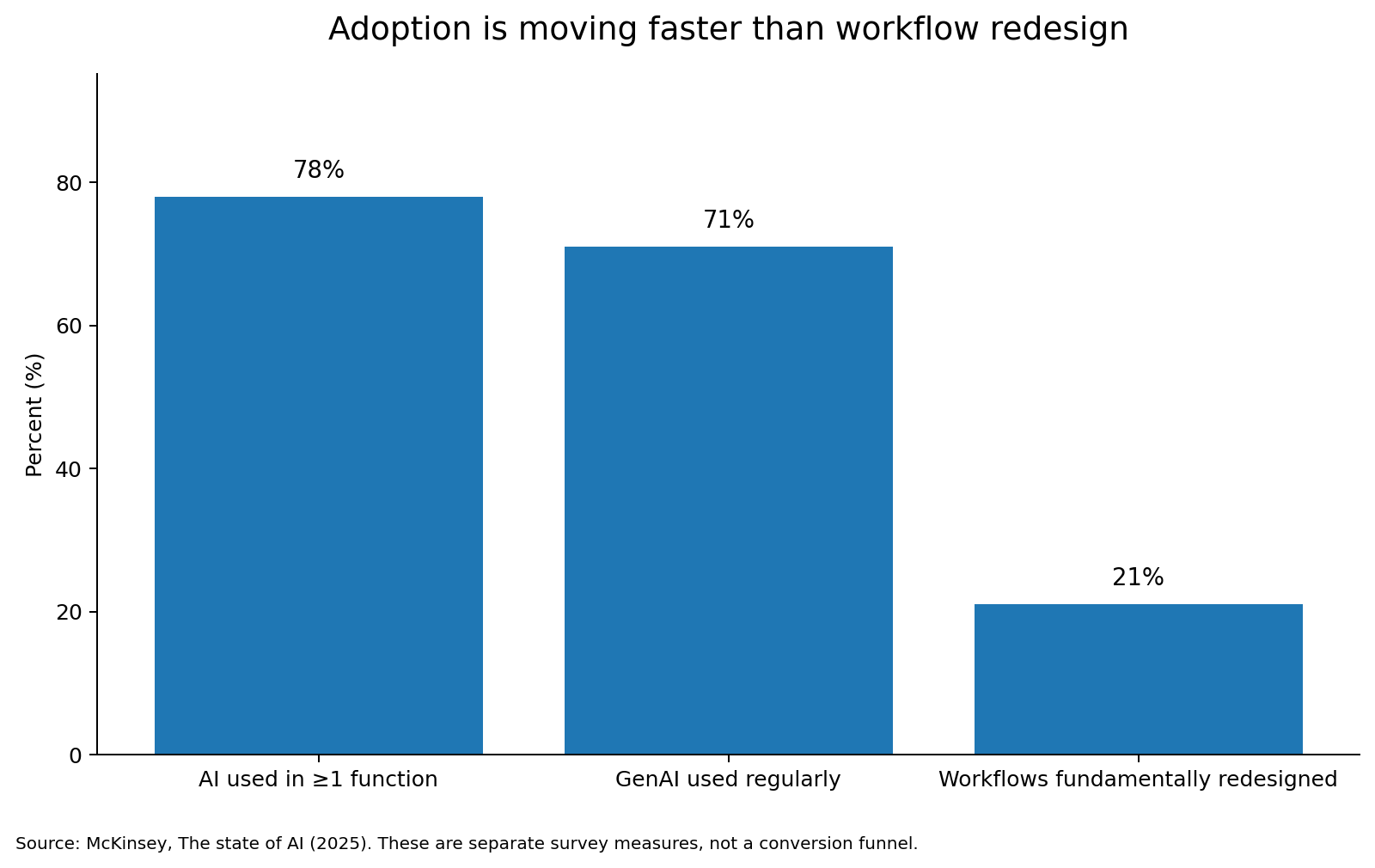
Enterprise AI adoption has moved rapidly. McKinsey’s 2025 State of AI survey reported that 78% of respondents said their organizations used AI in at least one business function, and 71% reported regular use of generative AI in at least one function.
But only 21% of respondents reporting gen-AI use said their organizations had fundamentally redesigned at least some workflows.
That gap matters.
Buying AI is not the same thing as redesigning work around AI.
McKinsey also found that workflow redesign had the strongest relationship, among the attributes it tested, with seeing EBIT impact from generative AI.
THE QUESTION
When a leadership team asks:
“Is our AI investment working?”
what evidence should actually answer that question?
Tokens do not answer it.
Seats do not answer it.
Agent runs do not answer it.
Even daily active users do not answer it.
Those are activity signals.
The business question is whether the activity produced a better outcome.
THE OBVIOUS ANSWER
Most dashboards start with what is easy to collect:
- model spend;
- token volume;
- licenses;
- active users;
- prompts;
- calls;
- sessions.
These metrics are useful for operations and cost management.
They are not ROI.
An AI copilot can have high usage because employees are forced to use it. An agent can complete thousands of runs while producing low-quality outputs that humans silently repair. A product can reduce task time while creating downstream review cost.
THE TENSION
The enterprise needs a chain of evidence:
AI asset → use case → owner → usage → quality → risk → cost → business outcome
If one part is missing, the interpretation becomes weak.
I would go one step further and require every material AI product to have an Outcome Contract:
| Outcome Contract field | Example |
|---|---|
| Business problem | Support resolution is too slow |
| Baseline | 18 minutes median handling time |
| AI intervention | Grounded support copilot |
| Expected outcome | Reduce median handling time without increasing repeat contact |
| Quality guardrail | Unsupported-claim rate below release threshold |
| Owner | VP Support |
| Review window | 60 days |
| Evidence source | Ticketing + eval + finance data |
Now the organization can ask something meaningful:
Did this product improve the outcome it was funded to improve?
MY PRODUCT TAKE
I think AI governance and AI economics are converging.
As enterprises add copilots, agents, APIs and embedded models, the operating problem becomes less about “Do we have AI?” and more about:
- What exists?
- Who owns it?
- What does it cost?
- What data does it touch?
- How well does it perform?
- Which business outcome is it supposed to affect?
- What should we scale, fix, consolidate or stop?
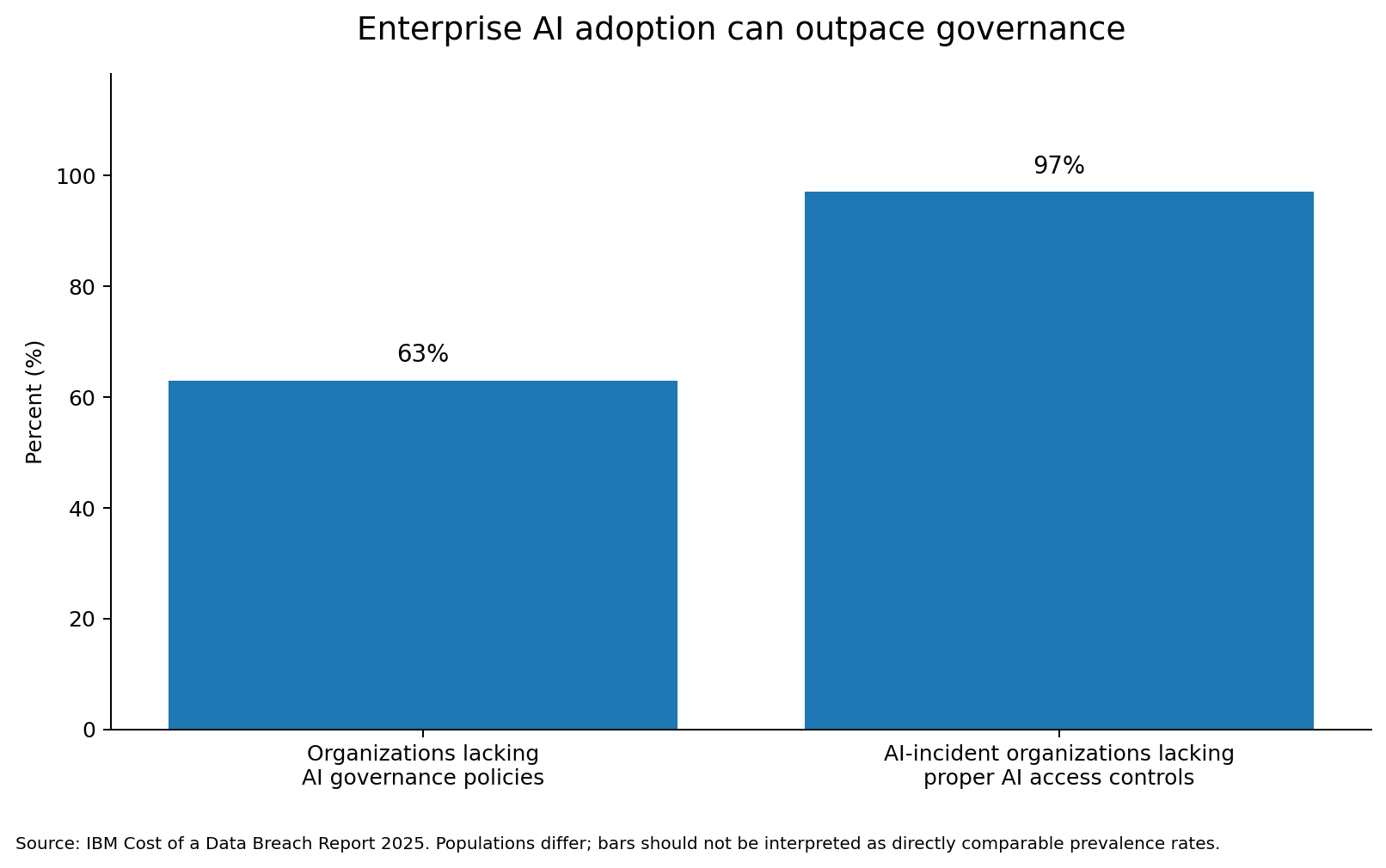
IBM’s 2025 breach research adds another reason the inventory matters: 63% of surveyed organizations lacked AI governance policies, and among organizations reporting an AI-related security incident, 97% lacked proper AI access controls. Those are different populations, but both point to the cost of letting an AI estate grow faster than visibility and control.
WHAT I WOULD TEST
For one enterprise, I would start with only five to ten AI assets.
For each one, reconcile:
vendor bill + internal usage + eval evidence + owner + business baseline
Then ask leadership to make a scale/fix/stop decision.
If the data does not materially improve the decision, we are collecting the wrong data.
WHAT WOULD CHANGE MY MIND
If organizations can make equally good investment decisions by joining their existing FinOps, observability and BI tools with minimal effort, a new AI decision layer may not deserve to exist.
That is why I would start with decision quality—not with a dashboard.
Secondary research
- McKinsey, The State of AI 2025 — https://www.mckinsey.com/capabilities/quantumblack/our-insights/the-state-of-ai-how-organizations-are-rewiring-to-capture-value
- IBM, Cost of a Data Breach 2025 — https://www.ibm.com/reports/data-breach
- NIST AI RMF — https://www.nist.gov/itl/ai-risk-management-framework